

Written by Logan Smith. Edited and published by Bonny Isselt.
When you walk into most libraries, you will find the same thing: hard chairs, stiff seats, and tables that belong in a waiting room. It functions. But it is not a space people want to linger in.
Reading is supposed to feel good. Hard seating fights that. After 20 minutes, you are shifting around, rubbing your back, and thinking about leaving. That discomfort quietly chips away at reading habits more than people realise.
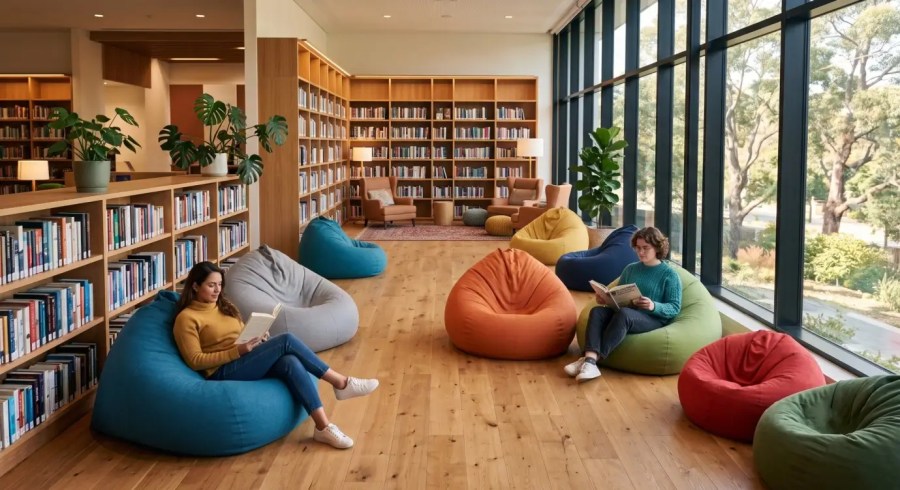
Bean bag chairs are changing this in libraries across Canada. Not as a gimmick, but as a practical fix. This article covers why they work and what to look for.
Table of contents
- Why Hard Chairs and Library Reading Have Never Really Gotten Along
- What Bean Bag Chairs Actually Do for a Library Reading Space
- Three Bean Bag Chairs That Work Well in Library Settings
- What to Look For When Choosing Bean Bag Chairs for a Library
- The Right Seating Can Actually Make People Want to Read More
Why Hard Chairs and Library Reading Have Never Really Gotten Along
- Standard library chairs are built to be functional, not comfortable. After 30 minutes of sitting in one, your lower back starts to ache, and you are shifting around more than you are reading.
- For children, it is worse. Kids have shorter attention spans to begin with, and physical discomfort gives them one more reason to stop reading and start fidgeting.
- Teen sections in libraries are among the least visited areas in the building. Uncomfortable seating is a big part of why. Most teenagers would rather read at home than sit in a chair that feels like detention.
- A space designed for leisure reading should feel like it. Hard chairs send the wrong message before anyone even opens a book.
What Bean Bag Chairs Actually Do for a Library Reading Space
They Make Staying Longer Feel Natural
A bean bag chair works with your body instead of against it. It shifts and moulds to how you are sitting, so there is no constant adjusting, no stiff posture to hold.
That sounds simple, but it makes a real difference when someone is trying to read for any length of time.
A child who normally reads for 10 minutes in a stiff chair will often stay for 40 in a bean bag. The chair stops getting in the way, and the book takes over. That is all you really need from library seating.
They Make the Space Feel Like It Is Meant for People
Furniture sends a message. Hard chairs say: sit up straight, get your work done, and leave. Bean bag chairs say something different.
They make a reading corner feel like somewhere people are actually welcome to settle in. Libraries that have updated their seating with softer, more casual furniture tend to see those areas fill up faster and stay in use longer.
People stay where they feel comfortable. When a space feels inviting, that is exactly how people treat it.
Layout Flexibility That Schools and Public Libraries Both Need
Hard furniture is fixed in more ways than one. A row of chairs stays a row of chairs. Bean bag chairs can be pulled into a circle for story time, spread out for individual reading, or moved to clear space for a group activity.
They are light enough that staff can rearrange them without it turning into an afternoon project. For libraries always balancing limited space against changing programming needs, that kind of flexibility matters a great deal.
Three Bean Bag Chairs That Work Well in Library Settings
The Classic Round Oversized Bean Bag
This is the most recognizable style. Large, round, and low to the ground, it is filled with EPS beads that hold their shape after repeated use.
Most versions come in microfibre or canvas in muted tones like navy or charcoal, which suit a library space without looking out of place.
Covers are usually removable and machine washable, which is a real advantage in a room used by kids aged six to twelve every day.
The High-Back Lounger Bean Bag
This one sits closer to a low chair than a traditional bag. The upright back gives actual lumbar support, making it a better fit for teenagers and adults who plan to read for longer periods.
It typically comes in water-resistant fabric or faux leather, both of which hold up well in busy spaces. Works well in teen zones or adult quiet areas.
The Pod-Style Bean Bag Chair
The pod wraps partway around the reader and creates a mild sense of enclosure.
For children who find open spaces distracting, this helps them settle and focus. It is usually filled with shredded memory foam, which makes it firmer and more supportive than bead-filled options.
It costs more upfront but holds up much better with daily use.
What to Look For When Choosing Bean Bag Chairs for a Library
- Choose commercial-grade microfibre or canvas over anything decorative. It cleans easier and holds up much longer in a busy space.
- Removable, machine-washable covers are non-negotiable. In a room full of children, that matters more than any design feature.
- EPS bead fills are affordable and light. Memory foam fills are firmer and hold their shape better with daily use.
- Match the size to the age group. An adult-sized bag in a primary school reading corner is more of an obstacle than furniture.
- For Canadian public libraries, check for fire-resistance certification. Most provincial building codes require it.
The Right Seating Can Actually Make People Want to Read More
Small changes to a space do more than most people expect. The right chair does not just fill a corner. It changes how long someone stays and how often they choose to come back.
Libraries are not just about books. They are about making a room where reading feels worth doing. Seating plays a bigger part in that than it usually gets credit for.
Bean bag chairs answer a problem most libraries have had for years. Comfort drives reading. It really is that simple.

 Dropner Graphic Explainer